Axiom CI
Role
Lead Product Designer
Platform
Enterprise web application
Users
Procurement · Accounts Payable · finance teams
Duration
6 weeks
Impact
A trust-first AI workflow that turns variance into a clear, accountable action
Axiom CI helps teams spot invoice and contract variance earlier, but the real product challenge was making that signal trustworthy. Reviewers need to understand why a finding matters, what evidence supports it, and what decision should happen next — without turning everyday operations into a data-analysis task.
Contracts contain the truth. Invoices contain the spend.
A commercial intelligence workflow — dense enough to be real, clear enough to review.
Procurement and finance teams work across contracts, amendments, master agreements, invoice lines, SAP data, and supplier activity. The challenge was not just to find variance — it was to make that finding reviewable, explainable, and actionable inside a workflow people could trust.
Axiom CI was designed to surface supplier Deviations in a single operating model without reducing review to blind automation. The product had to show not only the finding, but the reason behind it, the evidence supporting it, and whose decision it was to act next.
The experience needed to work for both strategic reviews and operational exceptions. One system had to explain a supplier relationship issue, a contract mismatch, an invoice irregularity, and the recovery path — without hiding the human judgment behind the final decision.
“The product could not stop at model-generated findings. It had to show what mattered, why it mattered, and what action completed the loop.”
— Axiom CI design brief29
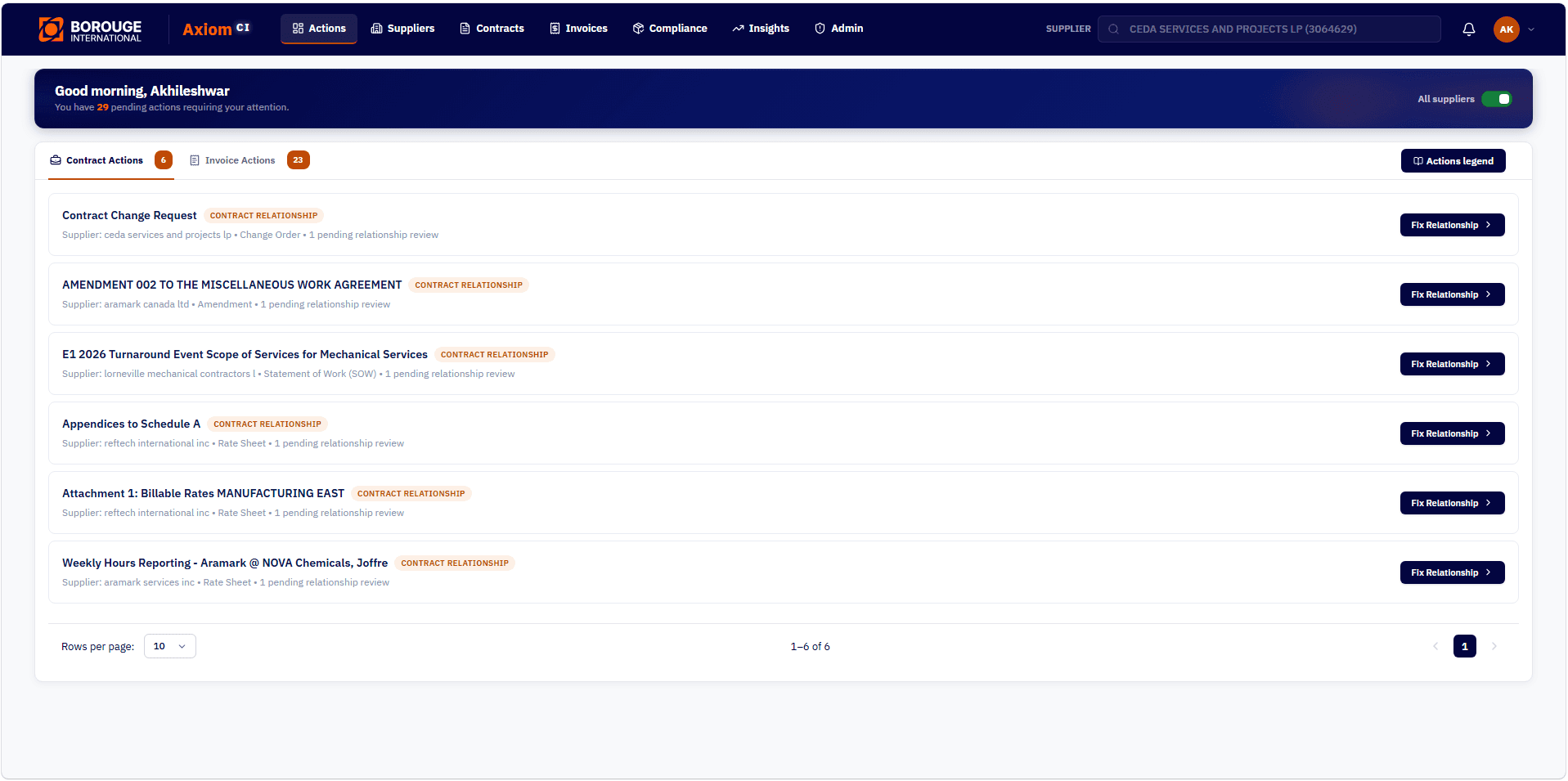
pending contract and invoice actions surfaced in one queue
6
contract relationship actions separated from invoice review
23
invoice actions organized into reviewable categories
1
shared value lifecycle spanning commercial and finance teams
The real problem was not detection — it was trust.
Evidence. Confidence. Accountability. Recovery.
The biggest usability issue was not that teams missed exceptions. It was that they couldn't quickly determine which exceptions were real, which were low confidence, and which required a relationship review versus an invoice line review.
Across operational reviews, procurement teams described a fragmented experience: one queue for supplier relationship actions, another queue for invoice variations, and no shared model for how a finding moved from AI suggestion to validated decision.
Design research made it clear that the interface needed to do more than summarize data. It needed to encode a decision flow: evidence first, action second, accountability always.
01
Queue clarity improved review momentum
The product organizes contract and invoice work into separate action streams, reducing cognitive collision between relationship decisions and invoice-level discrepancies.
“Reviewers knew what kind of action they were taking before they opened a case.”
02
Evidence needed to be visible at the decision point
AI suggestions were useful only when the user could inspect the source document, rate sheet, dates, and contract metadata without leaving the decision surface.
“The system had to explain itself without forcing users into detective work.”
03
Recovery only works when review is transparent
The value lifecycle is not just analytics. It is a proof chain — spend, variance, validation, recovery, and outcome all linked in one visible path.
“A business can only recover value if the work is legible and accountable.”
01
The product had to turn variance into a workflow people trust.
The core challenge was not finding exceptions. It was helping reviewers decide whether a variance was valid, supported by evidence, and safe to act on.
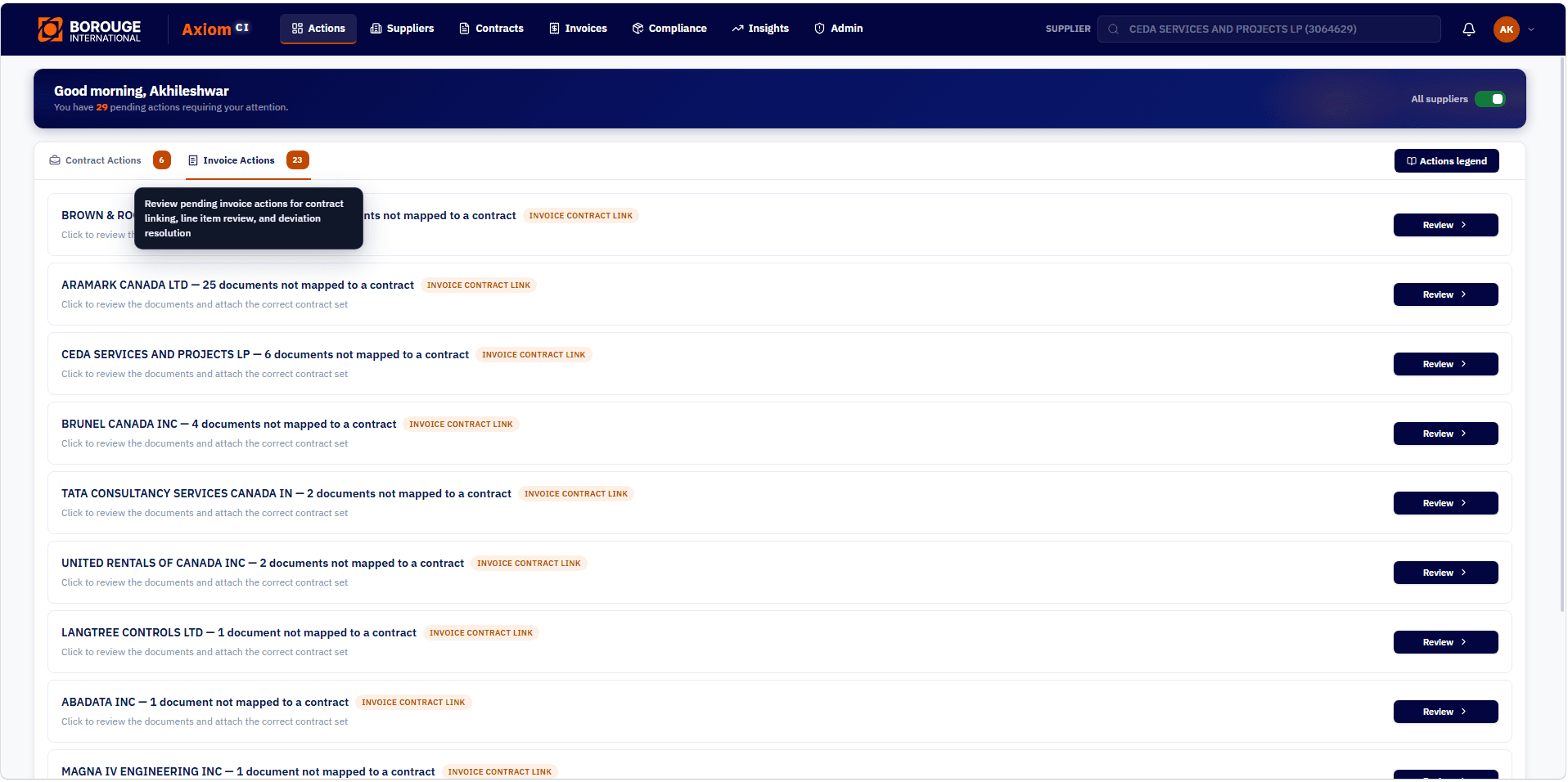
Workflow clarity: Contract and invoice tasks are differentiated before review begins, which keeps the review logic honest and easier to navigate.
Designing a value lifecycle not just a dashboard.
I started by mapping the work across the commercial lifecycle: supplier intake, contract context, mapping, invoice triage, deviation review, and recovery outcomes. The design challenge was to connect those stages in one coherent workflow without flattening their differences.
Each stage was designed to carry a distinct type of decision, supported by a consistent visual language for confidence, evidence, status, and ownership. The result is a product that feels like a system rather than a collection of isolated screens.
01
Supplier intake & scope definition
The review journey begins with a governed intake flow: invoice scope, document selection, historical versus new ingestion, and clear readiness indicators for the active supplier.
02
AI-assisted mapping & evidence review
Alias suggestions and confidence scores surface invoice language mismatches alongside contract metadata so a reviewer can decide whether a match is trusted or rejected.
03
Contract context & lifecycle visibility
The contract library shows document hierarchy, effective dates, OLA coverage, extraction confidence, and status — all in context with supplier relationship information.
04
Deviation review & recovery tracking
The invoice detail view reconciles spend, expected totals, actual totals, and case action in a single review experience, making recovery status visible and defendable.
Five decisions that made the workflow understandable. and trustworthy.
Each decision was shaped by one goal: reduce ambiguity without hiding complexity. The product needed to help users act with confidence, not just consume more data.
Separate relationship actions from invoice actions
The key insight was that a contract relationship issue and an invoice exception are two different kinds of decision. Mixing them in one queue creates confusion and weakens accountability.
By separating contract actions from invoice actions, the interface helps reviewers move through the right problem space without cross-contamination of decisions or state.
Impact
Teams can quickly tell whether they are addressing supplier-level contract health or invoice-level financial recovery without losing context.
Contract actions and invoice actions are each surfaced with distinct status, relationship, and action framing so review scope is obvious at a glance.
Turn ingestion into a controlled workflow
The supplier workspace strips away the ambiguity of bulk data intake. The three-step flow turns ingestion into a deliberate decision sequence: scope the document set, select the time frame, then execute the load.
This reduces operational risk by making the system explain what is being pulled in and what is left out, rather than silently processing a broad set of documents.
Impact
The workflow helps teams know when they are ready to act, while also making the no-filter state feel intentional instead of dangerous.
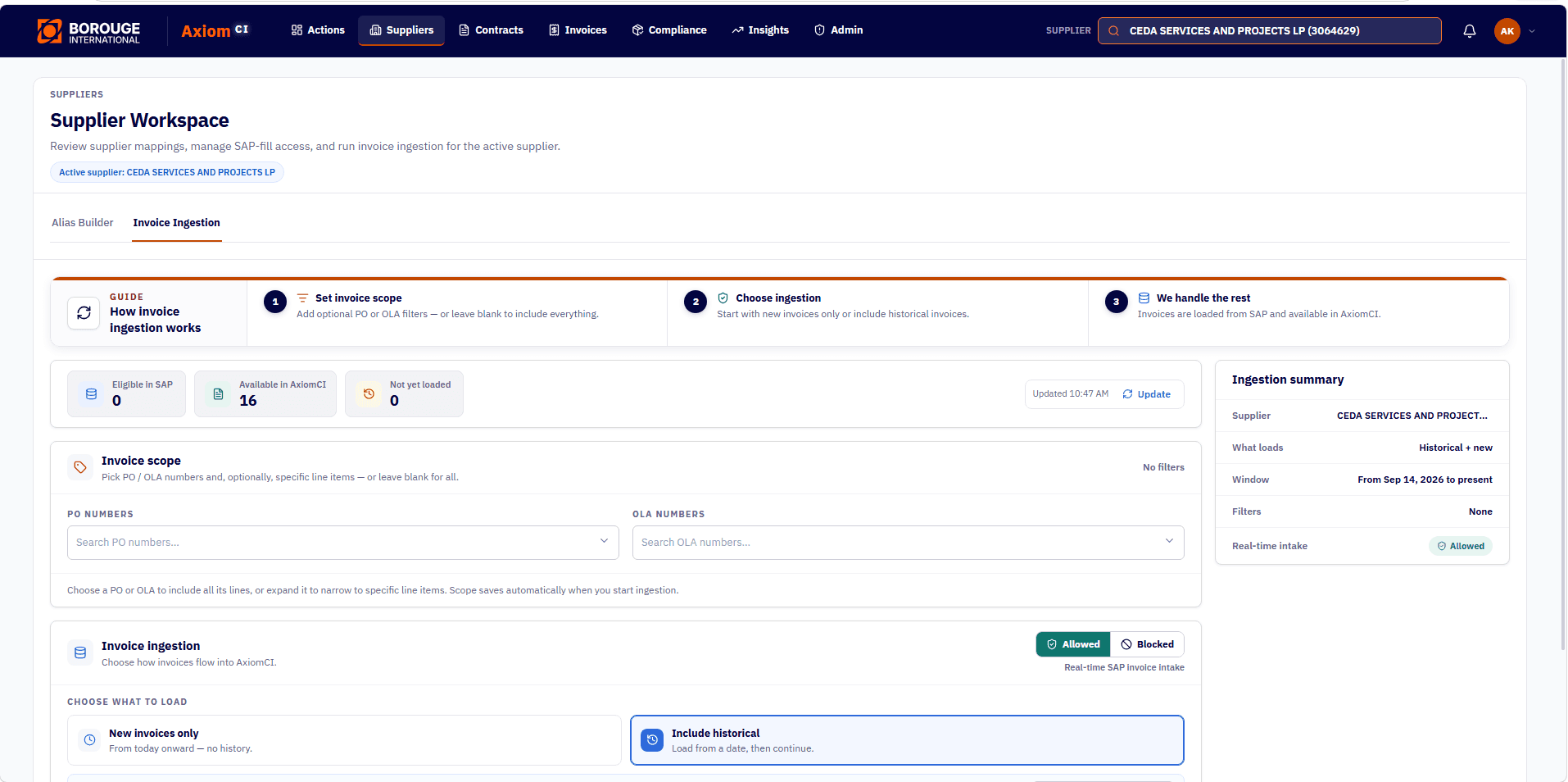
The supplier intake flow splits the task into controlled stages with explicit scope and status indicators to preserve operational confidence.
Make AI suggestions calibrated, not confident
The system uses confidence as a design signal rather than a hidden assumption. A match can be suggested without being accepted; a contract rate can be present without being definitive; a mismatch can remain visible as an unresolved result.
This respects the realities of enterprise data quality and keeps the reviewer in charge of the final decision, while reducing the chance that the interface becomes a black box.
Impact
AI becomes a decision accelerator rather than a decision substitute, which is fundamental in commercial recovery workflows with real financial consequences.
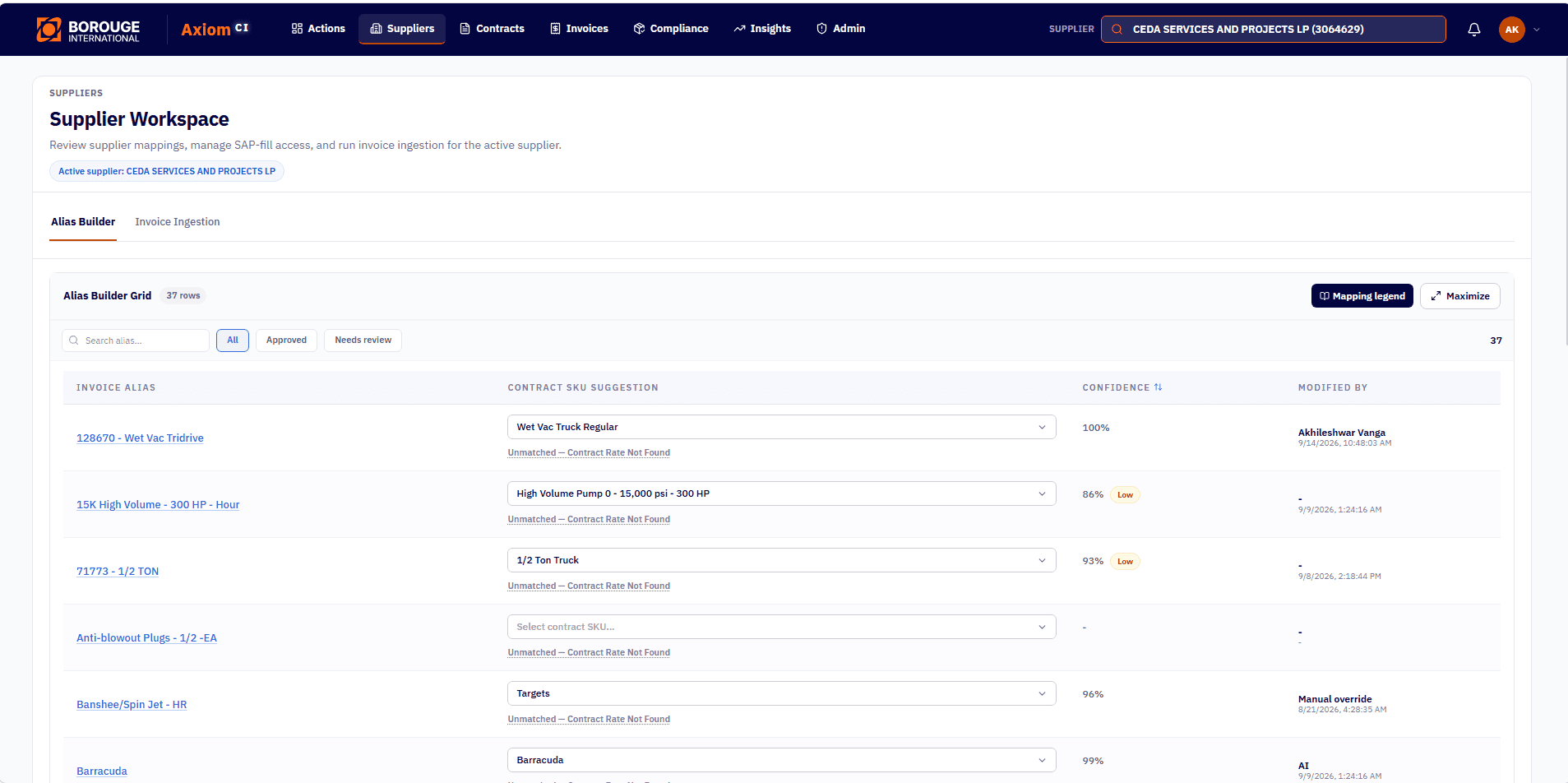
Alias Builder and contract mapping show confidence, unmatched states, and change ownership so the suggestion remains reviewable and accountable.
Put evidence beside the line item decision
At invoice review, the design brings expected versus actual totals, Deviation, line item logic, and source document metadata into one visual decision surface. The reviewer can see the anomaly and the basis for it without jumping through multiple screens.
This is where AI becomes operationally meaningful: the interface explains the variance while still letting a human validate and act on it.
Impact
The key review question — what is wrong, how do we know, and what is the next action? — is answered in a single place.
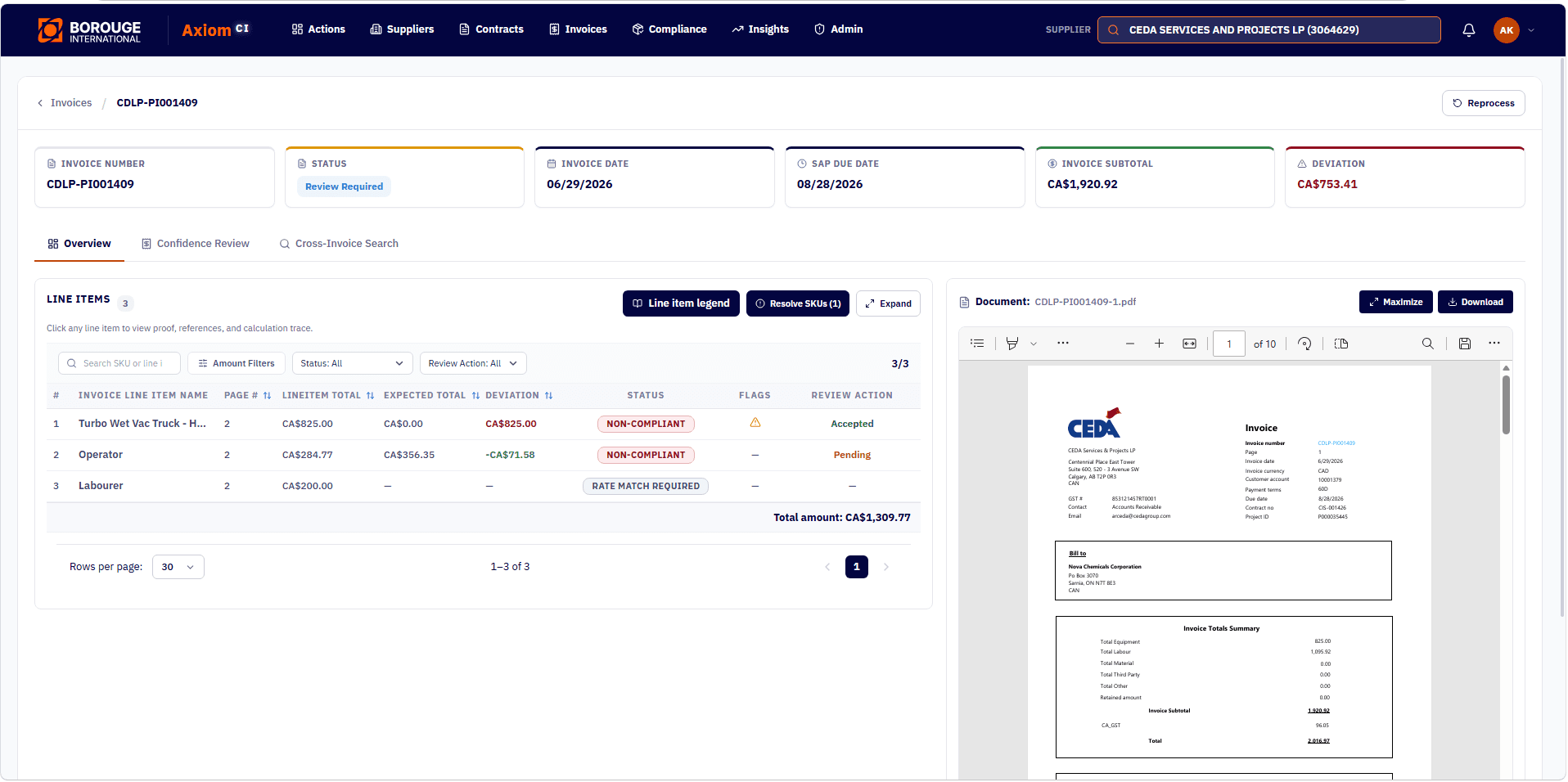
The invoice detail view reveals the line-item math and the contract relationship side by side, making the decision path legible and auditable.
Use neutral language that keeps review honest
The product uses terms like Deviation and review-required to describe variance without pretending certainty. This language is important because it creates a more defensible operational conversation between procurement, AP, and supplier teams.
Status legends and hover help decode the system at the moment of use, turning enterprise complexity into a teachable pattern instead of institutional knowledge.
Impact
The interface teaches itself in context, so trust grows through repeated use instead of training sessions or dense documentation.
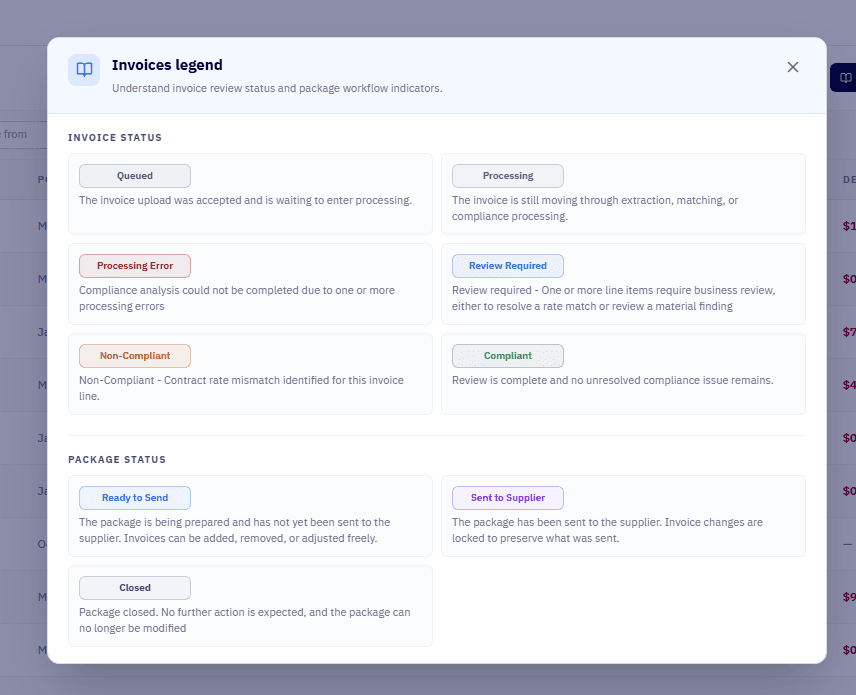
The Invoice Legend and contextual help make status semantics visible, reducing confusion around workflow states and action categories.
Designing inside real enterprise constraints. with operational consequences.
The system had to serve procurement, AP, and finance without creating a separate workflow for each. That meant supporting evidence-heavy review, layered document context, and cross-functional ownership in the same interface.
The product also had to respect business risk: a low-confidence match, an unmatched SKU, or a missing contract reference could not be hidden behind a confident-looking automated result. The interface had to surface uncertainty before the decision was made.
Cross-functional operating model
The workflow had to serve procurement, AP, finance, and supplier-facing recovery teams without creating different experiences for each discipline.
Evidence-heavy review
A deviation had to be traceable to a contract, a rate sheet, or an invoice line, not just an algorithmic output or a raw summary metric.
Risk-aware AI interaction
Low-confidence matches and unmatched fields had to remain visible and reviewable so teams never confused suggested intelligence with certainty.
Enterprise usability under complexity
The interface needed to account for layered contract rules, supplier relationships, and invoice logic without becoming impossible to scan or navigate.
Clear
decision paths
Trusted
AI-assisted review
Actionable
recovery workflow
Unified
commercial + finance view